
Lufthansa at 100 - The History of the German Flag Carrier

Lufthansa is an instantly recognized airline, not just in Europe but around the world. With its expansive route network and diverse fleet, along with the strength of the entire Lufthansa Group, the German flag carrier is well positioned as a leading European airline. In 2026, the airline will celebrate its 100th anniversary. In this blog post I take a look back at the airline's history and development. From its birth in 1926 to the introduction of jet aircraft into its fleet as well as the challenges it faced due to Covid-19, the airline has clearly impacted the entire aviation industry. The fact that the airline is still around 100 years later is amazing. Happy 100 years Lufthansa!

History and Development of Lufthansa
The origins of Lufthansa
The earliest predecessor to todays Lufthansa was Deutsche Luft Hansa AG, which was founded in Berlin in January 1926. This first Lufthansa emerged after the First World War as Germany tried to unify a post-war aviation landscape and create a national carrier for the country. Two early German airlines, Deutscher Aero Lloyd and Junkers Luftverkehr were merged to create this first Lufthansa.
From the start, Deutsche Luft Hansa operated as an air transport system, carrying passengers, cargo and airmail on European routes and beyond. The airline grew to connect more European capitals, and the airline played a significant role in developing early aviation standards, aircraft maintenance procedures and navigation techniques.
However, as a result of the rise of Nazi Germany in the 1930s, the airline's trajectory began to change. While Deutsche Luft Hansa still retained its commercial facade, its operations started to become more integrated with state objectives. During the Second World War, the company came under the authority of the German Air Force, the Luftwaffe, providing logistical support to the war effort. Operations turned from civilian transport to military logistics and maintenance, as well as the use of forced labor at maintenance facilities. After the defeat of Nazi Germany in 1945 and the allied occupation, all German civil aviation was grounded and Deutsche Luft Hansa ceased operations. All of its aircraft were seized and the company was formally liquidated by 1951.
After the Second World War, West Germany started rebuilding its place in the international community. This included the restoration of a national airline. On 6 January 1953, 27 years after the original Deutsche Luft Hansa was formed, a new airline called Aktiengesellschaft fur Luftverkehrsbedarf, abbreviated to Luftag, was founded in Cologne, with many of its staff having worked for Deutsche Luft Hansa before the war.
In 1953, Luftag ordered four Convair CV-340 and four Lockheed L-1049 Super Constellations aircraft, and set up a maintenance base at Hamburg Airport. On 6 August 1954, Luftag acquired the name and crane logo of the liquidated Deutsche Luft Hansa for 30,000 Deutsche Marks. This continued the tradition of a German flag carrier with that name. With this purchase, the Lufthansa that we know today was born.

On 1 April 1955, Lufthansa gained approval to commence scheduled domestic flights. The airline's initial network included Hamburg, Dusseldorf, Frankfurt, Cologne and Munich. The airline's international flights began on 15 May 1955, with flights to London, Paris, and Madrid. Flights to New York started on 1 June 1955 with the Super Constellation and flights across the South Atlantic started from August 1956.
1960s: The jet era
Lufthansa entered the jet age in 1958 with its order of four Boeing 707 aircraft, allowing the airline to launch jet flights between Frankfurt and New York in March 1960. The airline's network expanded in the early 1960s and by February 1961, Lufthansa's eastern destinations included Bangkok, Hong Kong, and Tokyo. These were joined in 1962 by Lagos and Johannesburg. Lufthansa also launched a polar route from Frankfurt to Tokyo with a stop in Anchorage in May 1964. Lufthansa also ordered 21 Boeing 737 aircraft in February 1965.
1970s - 1980s: The Widebody era
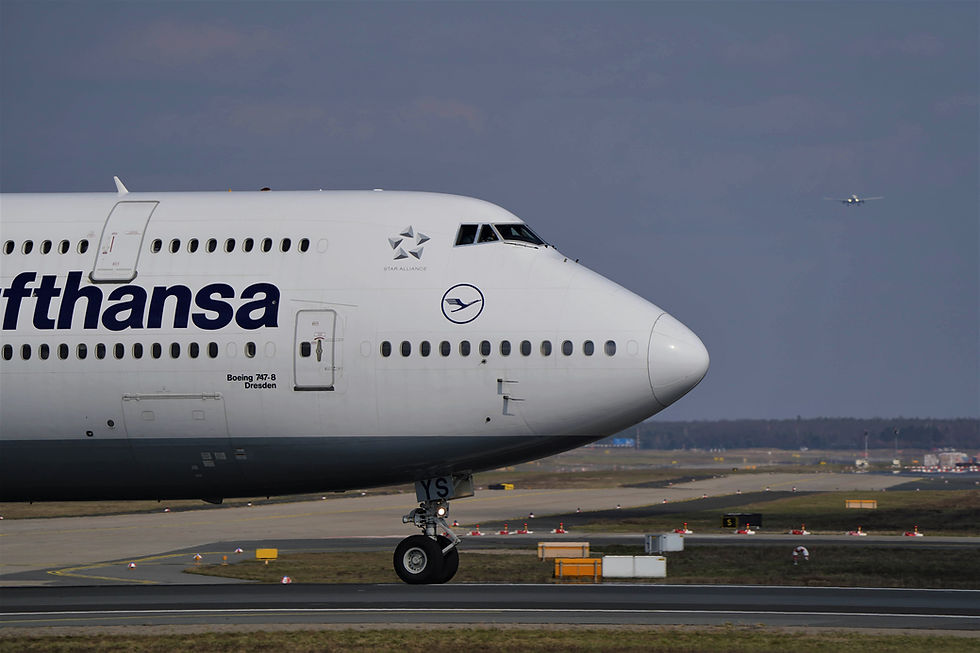
The German flag carrier entered the widebody era on 26 April 1970 with the Boeing 747. The airline also introduced the DC-10-30 in January 1974, the A300 in 1976 and the A310 in 1979. Lufthansa and Swissair became the launch customer for the type with an order for 25 aircraft. In 1985, Lufthansa ordered 15 A320s, 7 A300s and 10 Boeing 737-300s as part of its fleet modernization program. Lufthansa also bought A321s, A340s and 747-400s. The airline continued to modernize and adopted a new corporate identity in 1988. This resulted in the fleet receiving a new livery, white cabins, city offices and redesigned airport lounges.
1990s - 2000s
After the reunification of Germany in October 1990, Lufthansa started flying to Berlin within 25 days. The airline also underwent restructuring in the mid 1990s which created independently operated companies within the Lufthansa Group. This included Lufthansa Cargo and Lufthansa Technik.
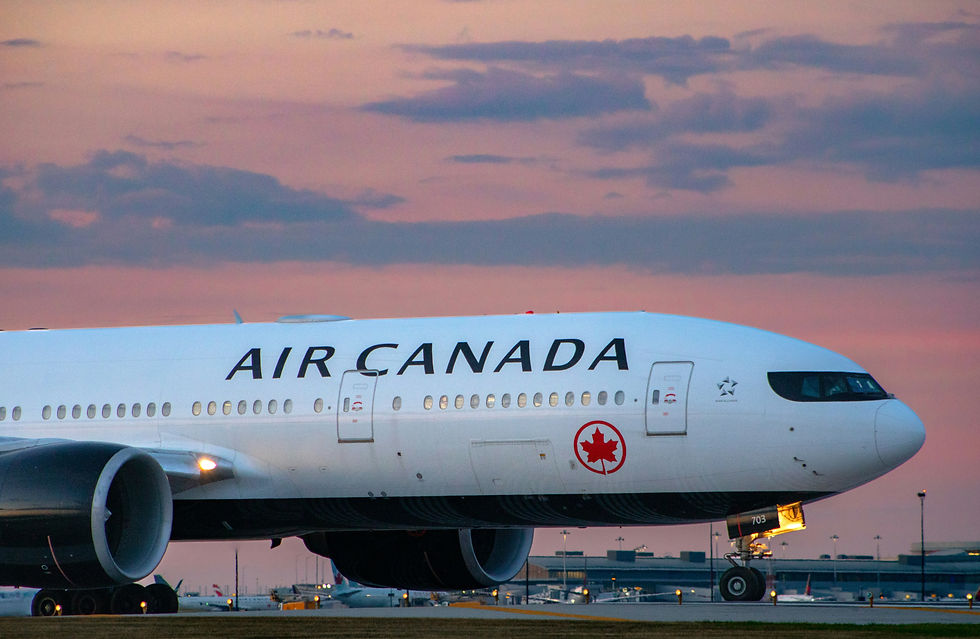
On 14 May 1997, Lufthansa joined Air Canada, Scandinavian Airlines, Thai Airways International and United Airlines to form Star Alliance, the world's first airline alliance.
You can read more about the Star Alliance in our blog post on this topic which is part of a series where I explore the three major airline alliances around the world. You can also explore the Oneworld and SkyTeam alliances by reading our blog posts on the topic.
In the early 2000s, Lufthansa was able to remain strong despite industry losses and the airline maintained profitability and avoided workforce reductions after the September 11 Attacks.
The airline continued to solidify its position as a key European airline through strategic acquisitions. The Lufthansa Group acquired Swiss International Air Lines in 2005, Brussels Airlines between 2009 and 2017, and Austrian Airlines in 2009. This expanded the Lufthansa Group's network.
Towards the end of the 2000s, Lufthansa bet big on big aircraft. The airline introduced its first A380 in 2010, the first of 14, and it became the launch customer of the Boeing 747-8i in 2012. Lufthansa purchased 19 747-8s.

2010s
In the first quarter of 2010, Lufthansa lost 298 million euros and it lost 13 million euros in 2011 due to the economic recession and restructuring costs. As a result, the airline cut around 20% of its administrative positions in 2012.
The airline announced a restructuring plan to improve its operating profit. As part of this plan, the airline started to transfer all of its short-haul flights outside its hubs in Frankfurt, Munich and Dusseldorf to the company's low-cost carrier Germanwings.
In 2013, the Lufthansa Group ordered 59 widebody aircraft, the group's biggest order, valued at more than 14 billion euros. Also in 2013, Lufthansa ordered 100 next generation narrowbody aircraft.
Lufthansa ended Boeing 737-500 operations on 22 March 2016 and the airline's last Boeing 737, a Boeing 737-300, was retired on 29 October 2016.
After the collapse of Air Berlin in 2017, Lufthansa took over 81 aircraft from the airline.
In December 2017, Lufthansa received a 5 star Skytrax certification, the first European airline to achieve this.
In March 2019, Lufthansa ordered 20 Boeing 787-9 aircraft and 20 A350-900 aircraft for its fleet expansion and replacement. Some of these aircraft were for other airlines in the Lufthansa Group. The airline also announced that it would sell 6 A380s back to Airbus starting in 2022.
2020s: COVID-19 and Recovery
On 19 March 2020, Lufthansa cancelled 95% of all its flights due to a travel ban as a result of the Covid-19 pandemic. As a result, the airline was losing 1 million euros per hour by April 2020 and while the airline managed to reduce its costs throughout the year, Lufthansa was still losing about 500,000 euros per hour on average at the start of 2021.
On 14 May, the Lufthansa Group announced that it planned to operate 1,800 weekly flights by the end of June. Lufthansa's recovery plan involved high-density cargo replacing paying customers.
On 25 June, Lufthansa shareholders accepted a 9 billion euro bailout which gave the German government a 20% stake in the airline.
In January 2021, the Lufthansa CEO announced that the Airbus A340-600 fleet, which was stored at the time, would be retired and not return to service. However, this was later changed and several A340s returned to service in June 2021.

In March 2022 the airline confirmed that all of its Airbus A380s would be retired. At the time they had been in storage since 2020. However, this decision was also reversed with plans to return some of them to service.
Lufthansa Centenary - special livery
As 2026 marks 100 years since Lufthansa was founded, the airline has rolled out a new livery celebrating this milestone. The livery appears on six of the airline's aircraft with one aircraft in each sub-fleet being painted in this livery. The most important sub-fleets of Lufthansa will receive a special 100 year anniversary livery. The livery has a blue fuselage which is adorned with a white crane whose wings merge into the aircraft wings. Additionally, a '100' is integrated on the left side of the fuselage and the lettering '1926/2026' is on the right hand side. A '100' is also visible on the underside of the aircraft. The anniversary livery will be applied to a Boeing 787-9, an Airbus A380, an Airbus A350-1000, an Airbus A350-900, an Airbus A320 and a Boeing 747-8.
Significant Accidents
Lufthansa has also experienced some aviation accidents in its history. Lufthansa flight 540 is one example. On 20 November 1974, Lufthansa flight 540 from Frankfurt - Nairobi - Johannesburg, operated by a Boeing 747-100, crashed and caught fire after takeoff from Nairobi, killing 54 passengers and 5 crew members. The cause of the crash was determined to be a stall caused by the leading edge slats having been left in the retracted position. This crash was the first fatal accident involving a Boeing 747 and the deadliest crash in Lufthansa's history.
When researching accidents affecting Lufthansa, (the airline, not the Lufthansa Group), I was interested to find that the airline has been the victim of many hijackings (all before the years 2000), Many of these hijackings had a political objective behind them. One interesting one happened on 11 February 1993 when a Lufthansa A310, operating Lufthansa flight 592 from Frankfurt to Addis Ababa, with a stop in Cairo, was hijacked by an Ethiopian man seeking asylum. The man forced the pilot to fly to New York City (which was nowhere near the aircraft's intended flight path). After being told that the plane would need to be refueled, the hijacker agreed to allow a refueling stop in Hannover, Germany. German authorities allowed the plan to depart after the hijacker threatened to kill his hostages, but promised to surrender peacefully upon reaching the United States. The aircraft landed safely at JFK and the gunman surrendered peacefully, and was sentenced to 20 years imprisonment.
Fleet
Over its history, Lufthansa has operated a wide variety of aircraft.
Lufthansa's historical fleet includes: the A300, A310, Boeing 707, Boeing 727, Boeing 737, McDonnell Douglas DC-10-30, Junkers Ju-52 and Boeing 767-300ER.

The airline's current fleet is made up of Airbus and Boeing narrowbody and widebody aircraft. These include: the A320 and A320neo, the A321 and A321neo, A319, A330, A340-300, A340-600, A350-900, A380, Boeing 747-400, Boeing 747-8, and the Boeing 787-9.
The airline does have plans for its future fleet. At the end of 2025, the Lufthansa Group had 219 aircraft on order which are scheduled to enter service by 2032. However it is important to note that this figure is from the Lufthansa Group and not all of these aircraft will enter service with Lufthansa itself, instead they may go to other airlines in the group. The German flag carrier has ordered 15 A350-1000s as well as 27 firm orders for the Boeing 777X with 14 options.
Routes and Destinations
Lufthansa operates a diverse route network, flying to 5 different continents. It does not fly to Antarctica or Australia.
In North America the airline flies to destinations such as Vancouver, Mexico City, Miami, Washington Dulles (IAD), New York (JFK), Newark, San Francisco, Montreal and more.
In South America it flies to destinations such as Bogota, Buenos Aires, Sao Paulo, Rio de Janeiro and more.
In Europe it flies to destinations including: London (LHR), Dublin, Madrid, Paris, Amsterdam, Rome, Copenhagen, Oslo, Stockholm, Helsinki, Warsaw, Nice and more.
In Africa it flies to Lagos, Nairobi, Cape Town, Johannesburg and more.
In Asia the airline flies to destinations including: Mumbai, Delhi, Singapore, Hong Kong, Beijing, Seoul, Osaka, Tokyo and more.
The Lufthansa Group
The German flag carrier is not a stand alone airline. As well as being a founding member of Star Alliance, the airline is also a member of the Lufthansa Group which includes several other airlines and companies. The Lufthansa Group is the second largest airline group in Europe by passengers. The airlines in the group include: Lufthansa, Austrian Airlines, Swiss International Airlines, Brussels Airlines, and ITA Airways (owned by Italian government (10%) and Lufthansa Group (90%) with options for full ownership in the future). Additionally there is also: Lufthansa City Airlines, Air Dolomiti (both of which are feeder airlines), Eurowings (which is a low cost airline) and Discover Airlines, Edelweiss Air and Sun Express (the last three are leisure airlines).

The Lufthansa Group also includes Lufthansa Cargo which handles cargo and logistics and the group has a 50% stake in the cargo airline Aerologic. The Lufthansa Group's maintenance, repair and overhaul (MRO) is handled by Lufthansa Technik.
Clearly Lufthansa is well positioned to be the German flag carrier and it is not surprise that it is a staple of European aviation and recognized around the world. With its diverse fleet of both narrowbody and widebody aircraft as well as its expansive route network, it is no surprise that the airline is keen to expand and solidify its position in the aviation industry.
What do you think about Lufthansa? With its fleet of aircraft which are becoming increasingly rare (such as the Boeing 747, A340 and A380), have you ever flown with the German flag carrier? How was your experience? Or what would you like to see Lufthansa do in the future? Feel free to share your thoughts by leaving a comment below, on our group discussion post, or on social media. You can also get in touch via the contact form or by email.
Thank you for reading.
X: avgeek_blog
Instagram: avgeek_blog
Email: geekofairlines@gmail.com
Date Published: 18 July 2026


Comments