
The history of Aer Lingus

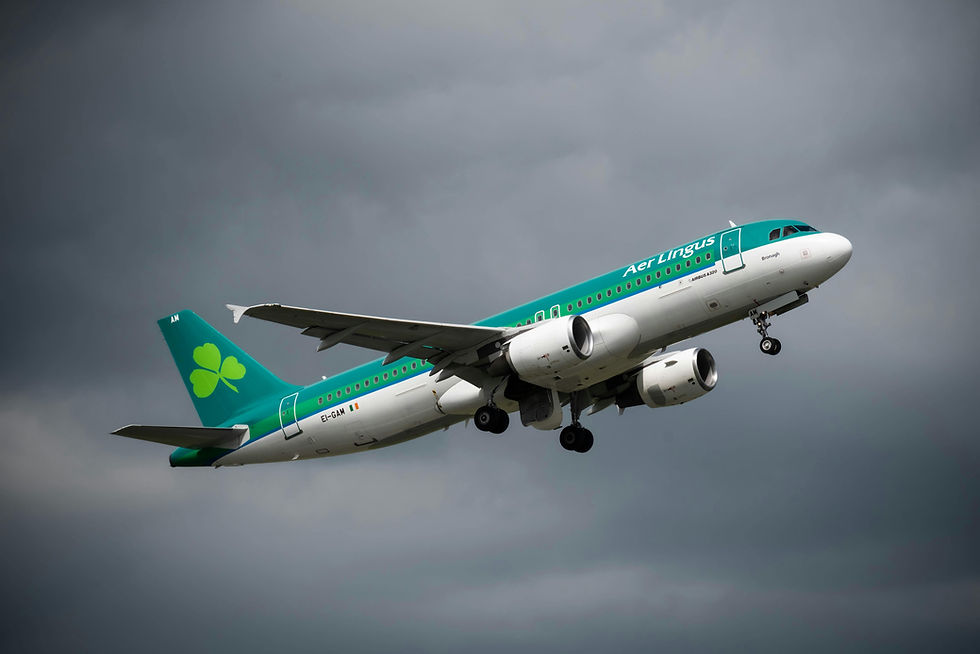
Aer Lingus, the flag carrier of Ireland, is hard to miss with its green, turquoise and white livery and its iconic shamrock tail sticking out at airports in Europe and North America. Based at Dublin airport, Aer Lingus focuses on connecting Europe and North America through Dublin. But did you know that Aer Lingus used to fly to Asia or that Ryanair tried to takeover Aer Lingus, not once, not twice, but three times. In this blog post, I will be diving into the history of Aer Lingus and looking at its history, its fleet and business modernization as well as its plans for the future.
History and development of Aer Lingus
Aer Lingus Teoranta was registered as an airline in 1936. Aer Lingus took delivery of its first aircraft, registered EI-ABI on 26th May 1936. This was the airlines first and only aircraft. Then, at 9am on May 27th 1936, the aircraft took off from Baldonnel on Aer Lingus's first flight to Bristol. In 1940, the airlines moved from Baldonnel to the newly completed Dublin Airport.
In 1958 Aer Lingus operated its first transatlantic service from Shannon to New York.
Aer Lingus entered the jet age in 1960 with the introduction of three Boeing 720 aircraft. These Boeing 720's covered the airlines routes from Dublin and Shannon to New York and Boston. The Boeing 720 was a success for the airline's transatlantic routes and Aer Lingus took delivery of the larger Boeing 707 in 1964.
In 1969, Aer Lingus introduced the Boeing 737-200. This aircraft was introduced to cope with high demand for flights between Dublin and London and the aircraft became the main aircraft for the Aer Lingus short haul fleet.
On 6th March 1971, the first Aer Lingus 747 was delivered to the airline for use on its transatlantic routes. Check out our blog post on the Boeing 747 to learn more about this iconic jet here.
In 1979, Pope John Paul II flew from Rome to Dublin and then from Shannon to Boston on a specially chartered Aer Lingus plane. The Pope is just one of the many famous people who have flown with the Irish flag carrier with others including the Irish Rugby teams, Olympic medalists and athletes for Special Olympics Ireland.
In 1994, Aer Lingus introduced the A330 on transatlantic routes. Aer Lingus was the first airline to operate an A330 under Extended-range Twin-engine Operation Performance Standards, or ETOPS, over the north Atlantic.

On 2nd October 1995, the last Aer Lingus Boeing 747 flight took place after 25 years. By that time over 8 million people had travelled across the Atlantic in an Aer Lingus jumbo jet.
The A321 entered service with the Irish flag carrier in 1998. This new aircraft type was initially used on the busy Dublin - London Heathrow route.
In May 1999, Aer Lingus used its newly delivered long range A330-200 aircraft to launch its new route to Los Angeles.
In June 2000, Aer Lingus introduced its first A320 into service on its busier continental routes.
Following the terrorist attacks of September 11th 2001, and the following uncertainty in the aviation industry, Aer Lingus implemented a survival plan. This included the introduction of a low fares model in order to compete with low cost carriers.
In October 2005, the airline withdrew its last 737-500 aircraft. With this fleet change, Aer Lingus became an all-Airbus operator, something it still is to this day.
In 2006, Aer Lingus launched its first long-haul destination outside of North America - Dubai in the UAE. Unfortunately, this route ceased in March 2008. At the time of writing, Aer Lingus still does not operate any flights to Asia.
In June 2007, Aer Lingus placed an order for 6 A350-900 aircraft. Unfortunately these A350 orders were assumed by IAG in 2015. Aer Lingus's only widebody aircraft is the A330. I would have loved to see Aer Lingus fly the A350. Unfortunately, this does not look to be happening any time soon as in May 2025, IAG announced an order for 21 A330-900s. These A330neos will be split across Aer Lingus, Iberia and LEVEL. In relation to Aer Lingus, these A330-900 aircraft will likely replace some or all of its current A330-200 and A330-300 aircraft.
The Open Skies Agreement was signed between the EU and USA in 2007 and came into effect in 2008. This agreement provided Aer Lingus with new opportunities to grow its long haul network. Aer Lingus did not delay and within an hour of the announcement, Aer Lingus announced three new routes to the USA - Washington D.C., San Francisco and Orlando.
Also in 2007, Aer Lingus carried over 1 million transatlantic passengers.
In 2008, Aer Lingus announced a partnership with JetBlue. This partnership connected Aer Lingus passengers to over 40 domestic US destinations. This was not the only agreement that the Irish flag carrier signed in 2007. Aer Lingus also signed a codeshare agreement with United Airlines. This agreement provided Aer Lingus passengers with access to over 200 US destinations on the United Airlines network.
In 2014 Aer Lingus launched two direct flights to North America - these were to San Francisco and Toronto.
In September 2015, Aer Lingus joined International Airlines Group (IAG), joining British Airways, Iberia and Vueling.
On 4th May 2016, Aer Lingus began its direct service to Los Angeles.
In March 2017, Aer Lingus launched its new loyalty programme - AerClub. This loyalty programme was paired with Avios which is used by many other airlines including British Airways, Finnair and Qatar Airways to name a few.
On 17th January 2019, Aer Lingus unveiled a refreshed brand with an updated logo and new aircraft livery.

Like many airlines, Aer Lingus was affected by the COVID-19 pandemic. Aer Lingus was forced to cut its route network and staff pay.
Aer Lingus and Ryanair
Aer Lingus, the Irish flag carrier and Ryanair, the European low cost Irish airline both operate many European routes from Dublin. Surprisingly, in October 2006, Ryanair launched a bid to buy Aer Lingus. This bid was rejected the same day. This rejection did not deter Ryanair and in December 2008, the airline launched a second takeover bid of Aer Lingus. Aer Lingus rejected this offer but Ryanair initially left the offer open to Aer Lingus until it withdrew its bid in January 2009. This second rejection still did not stop Ryanair and in June 2012, the airline announced its intention to launch another bid to takeover Aer Lingus. Aer Lingus rejected this offer. Ryanair's third bid to takeover Aer Lingus was blocked by the European Commission in February 2013.

Aer Lingus and IAG
Ryanair's bids to takeover Aer Lingus must have drawn attention from other airline groups, namely International Airlines Group (IAG) as in December 2014, IAG launched a bid to takeover Aer Lingus. This offer was rejected two days later. This did not stop IAG as they launched another bid which Aer Lingus rejected on 9th January 2015. This still did not deter IAG as on 24th January 2015, IAG launched a third bid for Aer Lingus. For IAG the third time was the charm as in May 2015, the Irish government agreed to the sale of its 25% stake in Aer Lingus and in July 2015, Ryanair voted to sell its nearly 30% stake in the airline. After approval by EU and US regulators, on 2nd September 2015, IAG assumed full control of Aer Lingus. As part of IAG, Aer Lingus has pledged to achieve net zero carbon emissions by 2050 as well as committing to powering 10% of its flights using SAF by 2030.
The Aer Lingus fleet
Throughout the years Aer Lingus has operated a wide range of aircraft.
Aer Lingus's past fleet for transatlantic routes include (but are not limited to): The Boeing 707, 720, 747-100, 757-200, 767-200ER, 767-300ER, DC-8 and Lockheed Constellation.
Aer Lingus also operated a European and commuter fleet which consisted of: A319-100, A321-200, ATR 42-600, Boeing 737, Fokker 50 and the Saab 340.
The Aer Lingus fleet today consists of all Airbus aircraft with the addition of ATR aircraft for its 'Aer Lingus Regional' branch. Read our blog post on the 'Aer Lingus fleet in 2025' here.
Table 1: The Aer Lingus fleet today (at the time of writing)
Aircraft | Number in fleet |
A330-300 | 12 |
A330-200 | 3 |
A321XLR | 3 |
A321neo LR | 8 |
A320neo | 8 |
A320 | 27 |
ATR 72-600 (Aer Lingus Regional) | 20 |
Aer Lingus has a total of 81 aircraft in its fleet at the time of writing.
Aer Lingus uses its A330 aircraft for high volume transatlantic traffic. However, the airline has previously used its A330's on European routes during the busy summer season. Aer Lingus was the launch customer for the A330 on an ETOPS route. Interestingly, the airline names its aircraft after Christian saints from Ireland.

Aer Lingus was meant to be the launch customer for the A321XLR, however, in 2024, IAG announced that Aer Lingus would no longer be the launch operator for the type due to labor disputes. Instead, the aircraft went to fellow IAG member, Iberia. Since then, the airline has received three A321XLR aircraft. You can read more about Aer Lingus receiving its first A321XLR here.
When it comes the airlines future fleet, Aer Lingus has ordered 6 A321XLR aircraft with three being delivered so far. Additionally, in May 2025 IAG ordered 21 A330-900neo aircraft for Iberia, Aer Lingus and LEVEL. It is not certain at this stage how these aircraft will be split across the IAG group.
Aer Lingus routes
Aer Lingus is mainly focused on connecting passengers between Europe and North America through Ireland. The airline operates over 100 routes from Dublin, Cork and Shannon to Europe, the UK and North America. The airline's main base is at Dublin Airport but it also operates from Belfast (mainly by Aer Lingus Regional), Knock, Shannon, Cork and Manchester (by Aer Lingus UK). Aer Lingus Regional uses ATR aircraft to operate within Ireland as well as regional routes between Ireland and Belfast to the UK and Isle of Man.
Aer Lingus operates to many European destinations including but not limited to: UK, Portugal, Spain, France, Canary Islands, Italy, Greece and more. When it comes to transatlantic routes Aer Lingus operate to Canada and the United States. It flies to Toronto in Canada. In the US it flies to: Seattle, San Francisco, Los Angeles, Denver, Minneapolis, Chicago, Indianapolis, Nashville, Cleveland, Orlando, Washington D.C. (IAD), Philadelphia, New York (EWR), New York (JFK), Windsor Locks and Boston. Aer Lingus also flies transatlantic from Manchester to North America and the Caribbean using the Aer Lingus UK brand.
Aer Lingus uses its new A321XLR aircraft on routes to Minneapolis, Indianapolis and Nashville. The A321XLR allows the airline to fly to destinations where demand may not fill a widebody but where other narrowbodies may not have the range to reach.

The future of Aer Lingus
Looking ahead is exciting, especially when it comes to airlines. We have discussed the airlines future fleet, its A321XLR's and A330neos but we do not know much else. It is likely that the Irish flag carrier will use its new XLR aircraft to expand into new routes, possibly in the USA but also other European or Middle East destinations. The new A330neo aircraft will likely replace the airlines aging A330-200s and A330-300s. They may also be used to increase capacity on current routes or expand into new markets.

It is clear that Aer Lingus is a well know carrier. I did not know that Ryanair attempted to take over the airline three times, although all unsuccessfully. Was there anything that surprised you? What would you like to see from Aer Lingus. Personally, I would like to see the airline take delivery of new aircraft such as the A350 as well as expand into new markets, perhaps not just to the USA but to Asia as well.
Feel free to share your thoughts in the comments below, on our group discussion or on our social media.
Thank you for reading.
X: avgeek_blog
Instagram: avgeek_blog
Email: geekofairlines@gmail.com
Date published: 5 November 2025


Comments