
From Dakotas to Voyagers: The aircraft Queen Elizabeth II flew throughout her life

Updated: May 2
21 April 2026, marks what would have been the 100th birthday of the late Queen, Queen Elizabeth II. To mark this milestone, I take a look back at how the late Queen travelled by air throughout her life.
Queen Elizabeth II's lifetime was one of the most dramatic periods of change in aviation history. From early propeller aircraft to long range jets, and even Concorde, her travels reflected the development of technology within aviation. The Queen did not fly solely on military aircraft, commercial airlines such as British Airways and Qantas played a key role in her journeys.
Early Royal Flights: The Propeller Era
Before becoming Queen in 1952, Princess Elizabeth's early long-distance travel took place with propeller aircraft such as the Douglas DC-3 (Dakota) and other military transports. These flights were slow, often requiring multiple refueling stops across continents.
The then, Princess's, 1952 Commonwealth tour, during which she would ascend to the throne while in Kenya, was undertaken using aircraft operated by the British Overseas Airways Corporation (BOAC), the predecessor to British Airways. At the time, long-haul flying was more of an endurance exercise, rather than a luxury experience.
On 31 January 1952, then Princess Elizabeth flew on a BOAC Argonaut. The Argonaut was an upgraded Douglas DC-4 produced by Canadair. This aircraft was nicknamed 'Atlanta'. Having landed safely in Nairobi on 1 February 1952, the plane repositioned to Mombasa, as it was not required to bring Princess Elizabeth and her husband back again. The plan was for the couple to go to Australia and New Zealand but that never happened.

When news broke that King George VI had passed away, now Queen, Elizabeth and her husband had to return to the UK immediately. An East African Airways DC-3 was flown in to take her to Uganda to meet up with the Argonaut.
BOAC and the dawn of long-haul royal travel
In the 1950s and early 1960s, BOAC aircraft became central to royal travel. Aircraft such as the Boeing 377 Stratocruiser and Boeing 707 introduced the Queen to the emerging world of pressurized, faster intercontinental flight. These aircraft were a major step forward: fewer stops, greater comfort, and the ability to connect the far reaches of the Commonwealth, and the world, more efficiently.
Queen Elizabeth II's first visit to the USA in 1957 began in Jamestown, Virginia after which she headed to Washington. The flight to Washington was undertaken by President Eisenhower's own Columbine III, the only Lockheed VC-121E ever built. Columbine III served as Eisenhower's personal airplane from 1954 until he left office in 1961. It was a military version of the L-1049 Super Constellation which stretched 18 feet longer than previous versions.
British Airways and the jet age
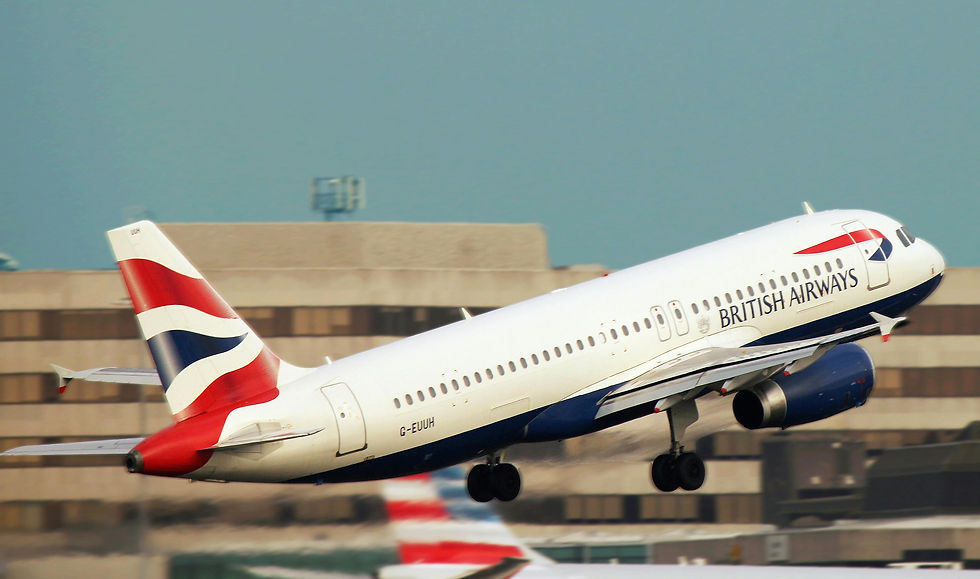
As BOAC evolved into British Airways, the airline became an important partner in royal travel. The late Queen flew on numerous British Airways aircraft, particularly for transatlantic and European journeys. Aircraft such as the Boeing 747 and Boeing 777 provided long-haul capability and modern comfort and reliability. While these were standard commercial aircraft, special arrangements were made to ensure privacy, security and protocol were maintained.
Qantas
As the flag carrier of Australia, Qantas frequently transported Queen Elizabeth II and other members of the Royal Family on tours to Australia and the pacific. Over the decades, the Queen flew on various Qantas aircraft, including the Boeing 707, and later the Boeing 747. In 1954, the Queen flew on a Qantas Boeing 707 and reportedly enjoyed a special regal menu, and a curtain with crown insignia separated the "Royal suite" from the rest of the cabin.

Boeing 747
The introduction of the Boeing 747 in the 1970s revolutionized air travel. With its increased range and capacity, travel to Australia became more efficient. The Queen regularly flew on Qantas 747 aircraft to Australia. On 18 February 1992, the Queen and Duke of Edinburgh arrived at Sydney's Kingsford-Smith Airport on a Qantas 747 aircraft.
In 1995, the Queen took a regular commercial flight to New Zealand for an official 10 day state visit. She travelled from London to Auckland via Los Angeles on NZ1, which was at the time, Air New Zealand's flagship route, using the Boeing 747-400 aircraft. For the flight, the airline reportedly blocked out the entire first class cabin and allocated 3 cabin crew to look after her during the trip. There were 26 royal staff in business class and 384 regular fare-paying passengers in economy. Passengers were reportedly subject to tighter than normal security but were given a special commemorative pen to celebrate the flight.
The Boeing 777
In March 2006, the Queen flew on a British Airways Boeing 777-200ER. The Queen flew to Canberra after a stopover in Singapore before flying to Melbourne for the Commonwealth Games. Five days later, the Queen flew back on the same aircraft.
In 2011, the Queen and Duke of Edinburgh flew on another British Airways 777-200ER for the Queen's Australian tour. This flight marked the airlines first non-stop flight from Perth to London.
Concorde: A Supersonic Chapter
One of the most famous aircraft the Queen flew on was the Concorde. Concorde represented the pinnacle of speed and luxury in aviation. Flying at over twice the speed of sound, Concorde allowed the Queen to cross the Atlantic in just a few hours. The Queen flew aboard Concorde for the first time in 1977. The aircraft was flown by British Airways and marked the Queen's first supersonic flight as well as the first time the Concorde landed in Barbados. After this, the Queen travelled on Concorde to Kuwait in 1979, Barbados in 1987 and 2003, to the Middle East in 1984 and to the USA in 1991.

The RAF and dedicated royal aircraft
Alongside commercial airlines, the Royal Air Force played a central role in transporting the Queen. Aircraft such as the Vickers VC10 became iconic symbols of British VIP transport, particularly during the 1960s - 80s. The VC10s performance in hot conditions made it ideal for visits to Africa and Asia. Later the BAe 146, operated by No. 32 (The Royal) Squadron, became the go-to aircraft for short-haul trips within Europe.
In the 2010s, the Airbus A330 Voyager entered service, offering a modern, flexible aircraft for long distance travel. Though not exclusively royal, the aircraft could be configured for VIP missions when required.

Helicopters: The Royal "last mile"
While fixed wing aircraft carried the late Queen across continents, helicopters played a vital role in day-to-day transport, particularly within the United Kingdom. The Queen regularly used helicopters operated by the Royal Household and RAF to travel between royal residences such as Buckingham Palace, Windsor Castle and Balmoral. These flights eliminated long road journeys, allowing the Queen to maintain a busy schedule.
Aircraft such as the Westland Wessex were used in earlier decades, later replaced by more modern aircraft such as the Sikorsky S-76. These helicopters were typically configured for comfort and practicality rather than luxury, reflecting the functional nature of these short trips.
Helicopters were also crucial for reaching remote or rural destinations. For many engagements, they served as the "last mile" connection between major airports and final destinations.
In many ways, helicopter travel became one of the most constant elements of the Queen's aviation journeys, quietly underpinning many official engagements over decades.
The Queen's final flight
Queen Elizabeth II's final flight was from Edinburgh to London on 13 September 2022, when her coffin was brought back to London. This flight was operated by a Royal Air Force Boeing C-17 Globemaster III with the callsign "Kittyhawk 01R". The journey began at Edinburgh Airport and concluded at RAF Northolt near London.

On FlightRadar24, there were 6 million attempts to track the flight within the first minute of its transponder activation.
Queen Elizabeth II's aviation story is not defined by a single aircraft, but by an entire lineup - from Dakotas and Stratocruisers to VC10s, 747s, Concorde and modern military transports. In doing so, she witnessed aviation change through her reign.
Thank you for reading
Feel free to share your thoughts by sharing a comment below, on our group page or on our social media. You can also email Av Geek Blog or use the contact form on the website.
X: avgeek_blog
Instagram: avgeek_blog
Email: geekofairlines@gmail.com
Date published: 21 April 2026
Updated: 2 May 2026


Comments